
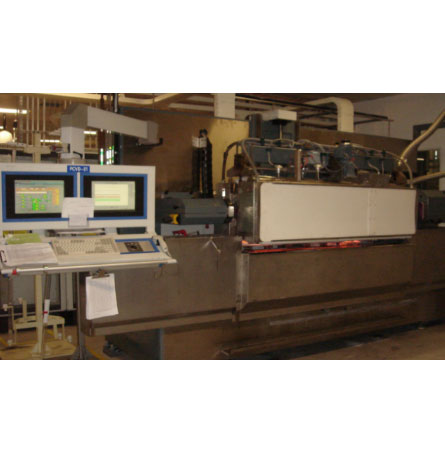
The PCVD process is a rod making technique that uses plasma activated reactive gases to produce uniform high-purity deposition materials such as germanium dioxide (GeO2), phosphorus pentoxide (P2O5), silicon oxyfluoride (SiOF2), etc. on the inner surface of the substrate, forming core and cladding layers with different refractive indices to achieve total reflection, low loss, and high capacity of optical signals propagating in the fiber core.
• The PCVD technology can produce a variety of products: communication optical fibers; Sensor fiber, amplifier fiber, or other special fiber, etc
• All gases in the PCVD rod making system undergo local particle filtration (0.003 μ) and pressure regulation control, with high precision in process line control
• The PCVD rod making system uses a user-friendly human-machine interface, is easy to operate
• The PCVD rod making system can provide lathes of different lengths: 2100~3000mm
| Features | Unit | Index |
|---|---|---|
| Prefabricated parts specification | mm | ≤φ50 |
| Diameter measurement | mm | φ5-φ40 |
| Diameter measurement accuracy | mm | ±0.05 |
| Typical control accuracy during deposition | mm | 0.15 |
| Maximum end spacing of chuck | mm | 2100 |
| Chuck through hole size | mm | φ110 |
| Hot zone operating range | mm | 1600 |
| Chuck clamping range | mm | φ10~φ125 |
| Maximum rotating speed of chuck | r/min | 100 |
| Moving speed of lamp holder | mm/min | 3~3000 |
| Working temperature range | ℃ | 1650~2100 |
| Temperature measurement range | ℃ | 900~2500 |
All rights reserved © 2026 Wuhan Hengtu Innovation Technology Co., LTD. Support:Intwho